What Is the UIDAI Biometric Challenge?
The UIDAI Biometric SDK Benchmarking Challenge, run jointly by India's Unique Identification Authority of India (UIDAI) and the International Institute of Information Technology, Hyderabad (IIIT-H), is one of the most rigorous biometric evaluation frameworks in the world. Unlike commercial vendor benchmarks, academic lab evaluations, or synthetic dataset tests, this challenge uses actual Aadhaar enrollment biometric data, collected from real citizens across India's full demographic spectrum.
The benchmark covers three modalities: fingerprint (completed in 2025, IDBIO did not take part), and face and iris matching. IDBIO entered and excelled in both face and iris, securing #1 in Iris Matching and #2 in Face Matching.
The Real Challenge: Age-Invariant Biometrics in Children
The hardest problem in large-scale biometric identity is not 1:1 matching between two recent samples. The hardest problem is matching a biometric captured today against one enrolled years (sometimes a decade) ago, especially in children aged 5 to 18.
This is the precise stress case the UIDAI challenge targets. Children enrolled in Aadhaar between the ages of 5 and 10 are re-captured years later, with a minimum gap of 5 years between the enrollment template and the probe sample, spanning some of the most rapid periods of biological development in human life.
Understanding the Metrics
The UIDAI challenge measures accuracy only — no speed benchmarking — on real field-tested data. Four numbers tell the story:
- FNMR (False Non-Match Rate): How often the system wrongly rejects a genuine person. In Aadhaar, every FNMR point is a citizen denied a service. Lower is better.
- FMR (False Match Rate): How often an impostor is incorrectly accepted. Lower means tighter security.
- AUC (Area Under Curve): A single 0–1 score summarising overall accuracy across all thresholds. 1.0 is perfect; 0.99 is exceptional. IDBIO scores 0.99 on both Face and Iris.
- DET Curve: Plots FNMR vs FMR at every possible threshold. The closer the curve hugs the bottom-left corner, the better the algorithm performs at all operating points simultaneously.
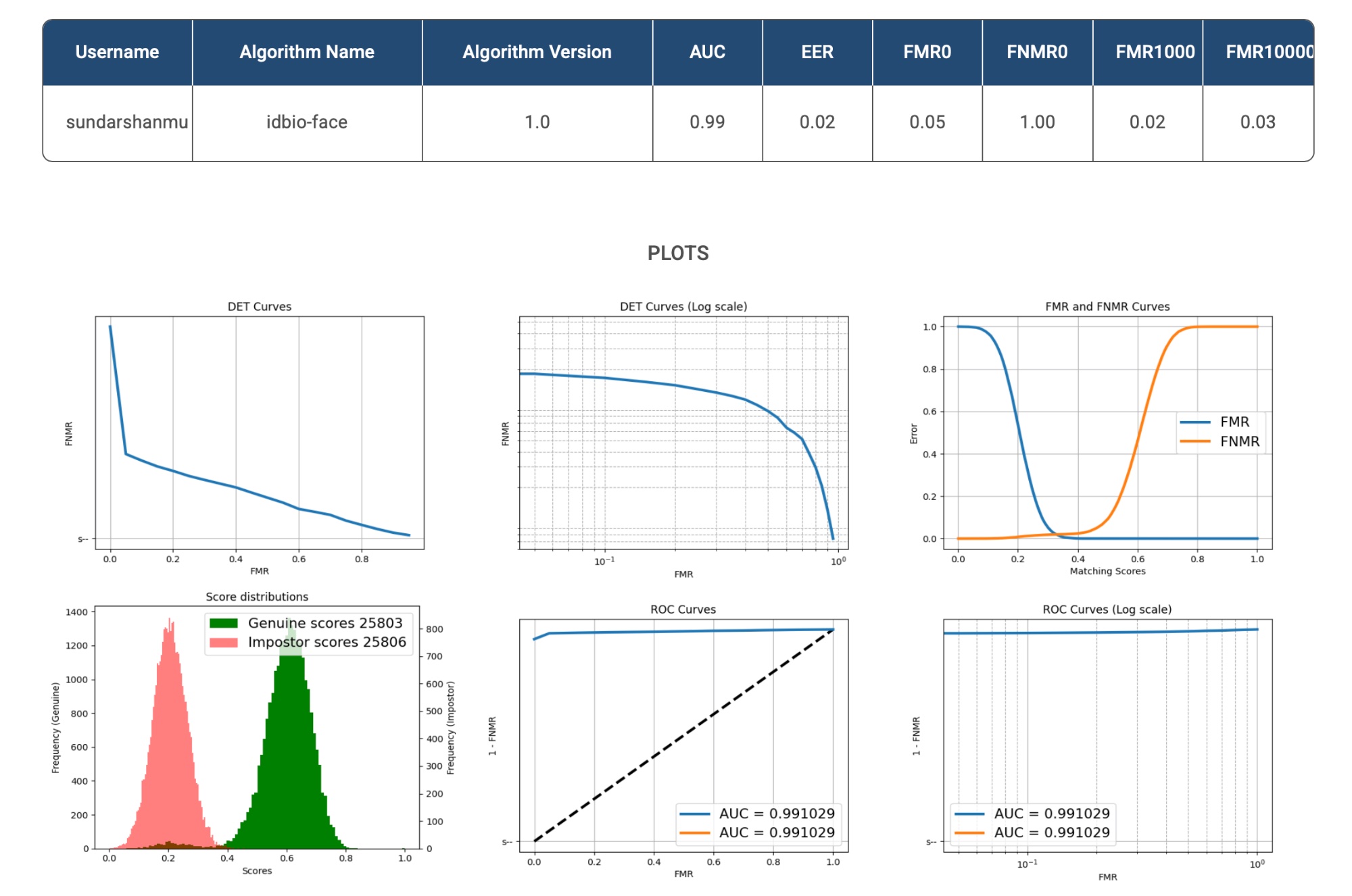
Official UIDAI Biometric Challenge result for idbio-face. 25,803 genuine pairs · 25,806 impostor pairs. View on UIDAI →
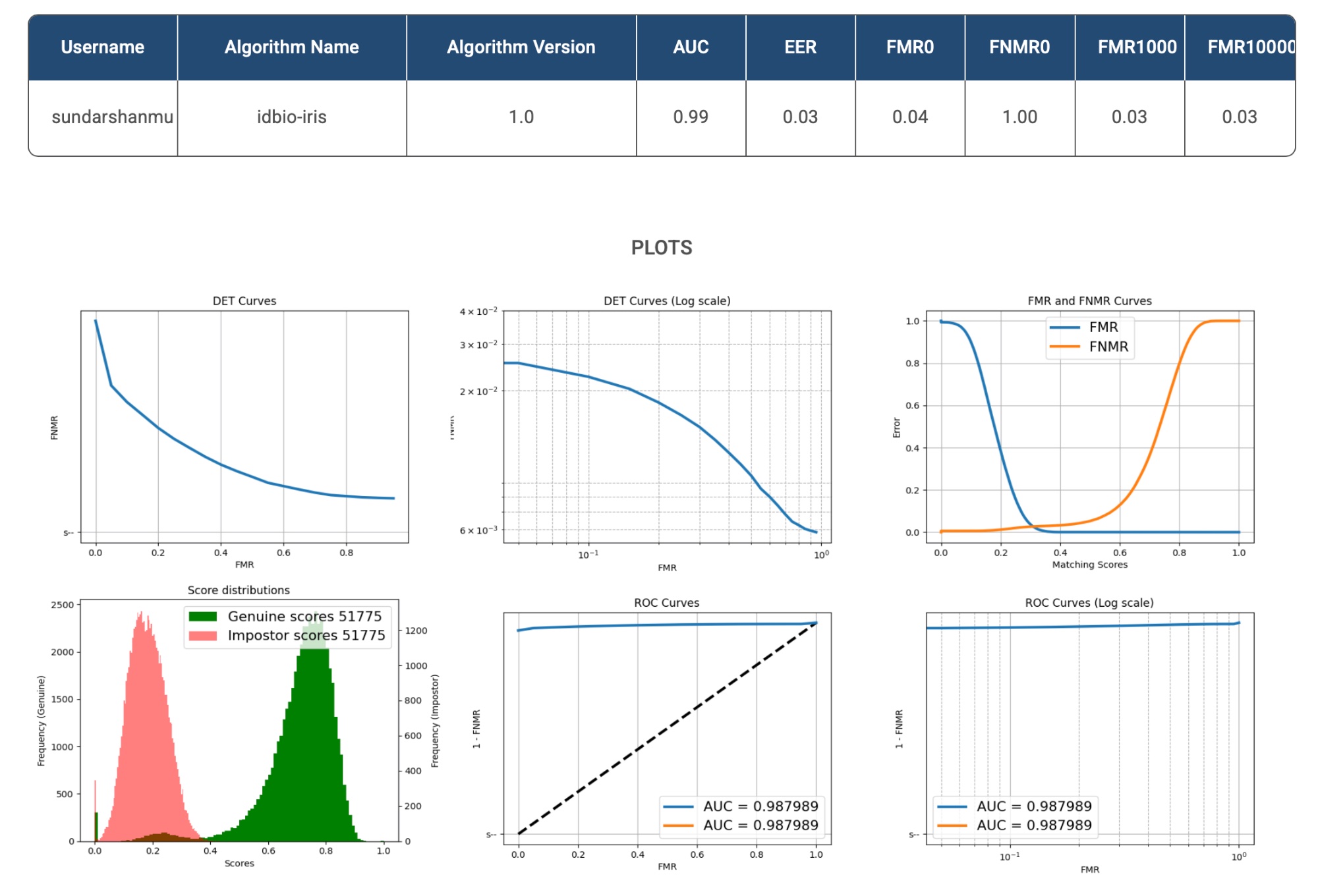
Official UIDAI Biometric Challenge result for idbio-iris. 51,775 genuine pairs · 51,775 impostor pairs. View on UIDAI →
IDBIO's Iris Performance: #1 on the Leaderboard
IDBIO's Iris Intelligence engine ranked first on the UIDAI Biometric Challenge for iris matching. The key performance characteristics of our engine that drove this result:
What makes iris matching particularly challenging in the UIDAI dataset is the variability in capture conditions across India's geography: different sensor types at enrollment centers, varying ambient lighting, and the physiological changes in the iris during the critical 5 to 18 year development window. IDBIO's algorithm demonstrated consistent performance across all these variations, maintaining very low FNMR even at strict FMR operating points.
IDBIO's Face Performance: #2 on the Leaderboard
IDBIO's Neural Face Engine ranked second in the Face Matching challenge. Face recognition across a 5 to 10 year gap in children and teenagers is among the most difficult problems in the field. Most general-purpose face recognition systems trained on adult datasets fail significantly in this regime.
The Child Biometric Problem: Why Most Algorithms Fail
The majority of commercial and academic biometric algorithms are benchmarked and trained on adult populations. When deployed in national ID systems that enroll children (as Aadhaar does, with mandatory enrollment updates at age 5 and 15), these algorithms encounter a failure mode that standard benchmarks never surface.
Research on pediatric iris recognition (including longitudinal UIDAI studies) confirms that FNMR can reach 1% or more across 5 year gaps for many commercial matchers, which translates to millions of rejected authentications at Aadhaar's scale of 80 million daily transactions. IDBIO's algorithms are specifically architected to handle this temporal drift, using models fine-tuned on demographically diverse populations including children across different stages of development.
How IDBIO Compares to the Competition
The UIDAI challenge attracted participants from global biometric vendors. The top performers for fingerprint (Neurotechnology at 0.99 AUC, Innovatrics, and Ooru Digital) had access to the same kind of difficult longitudinal dataset. For face and iris, IDBIO's standing at the top of the leaderboard represents validation against the world's best algorithms operating on the world's most operationally relevant dataset.
Lower is better. Smaller bar = fewer missed genuine matches. Evaluated on real Aadhaar field data with age variation.
What This Means for Government and Enterprise Deployments
For any national ID program that enrolls minors (which includes most programs in South Asia, Africa, and Southeast Asia), the UIDAI benchmark result is directly actionable evidence. An algorithm that fails on age-varied child data generates systematic exclusion. Children who enrolled years ago get rejected at the point of service. IDBIO's top-two ranking directly addresses this operational risk.
Combined with IDBIO's MOSIP-certified Enterprise ABIS, which supports multi-modal fusion of Face, Finger, and Iris at billion-record scale with sub-second search. This benchmark validates the full stack, from matching algorithm to national deployment infrastructure.
Verification
The UIDAI Biometric Challenge leaderboard is publicly maintained by UIDAI and IIIT-Hyderabad. Both iris and face results can be verified directly: