What Is NIST IREX 10?
The NIST Iris Exchange (IREX) 10 evaluation, conducted by the National Institute of Standards and Technology, is the gold standard for iris recognition testing globally. Unlike vendor-controlled benchmarks, NIST evaluations are conducted independently on standardized datasets using rigorous, reproducible methodology. IREX 10 evaluates one-to-many (1:N) iris identification accuracy, search speed, and template characteristics across submissions from the world's leading biometric technology providers.
The evaluation tests algorithms against large-scale gallery searches, measuring False Negative Identification Rate (FNIR) at controlled False Positive Identification Rate (FPIR) thresholds. It is the single most authoritative benchmark for iris recognition technology worldwide.
IDBIO's IREX 10 Results: The Full Picture
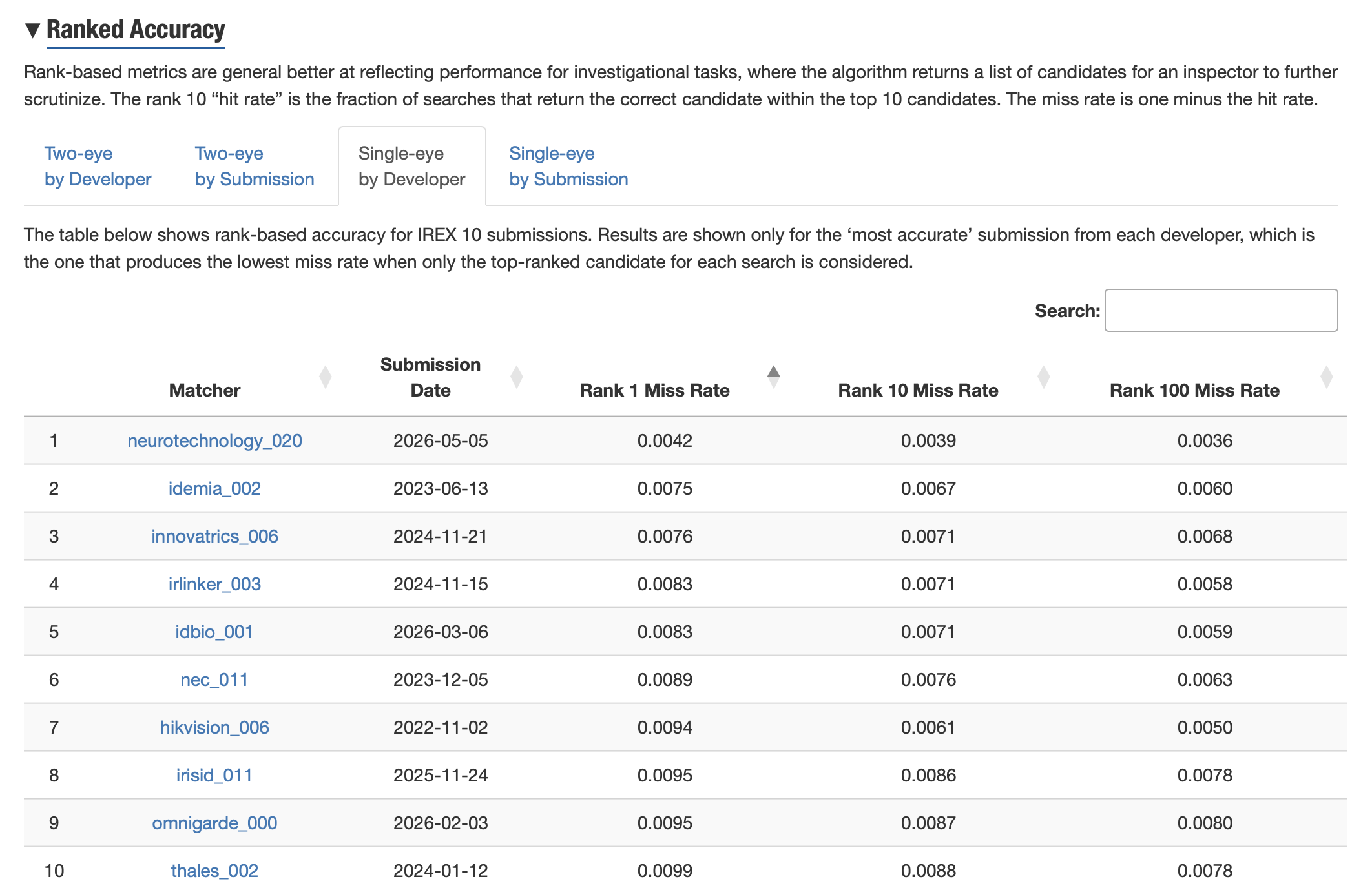
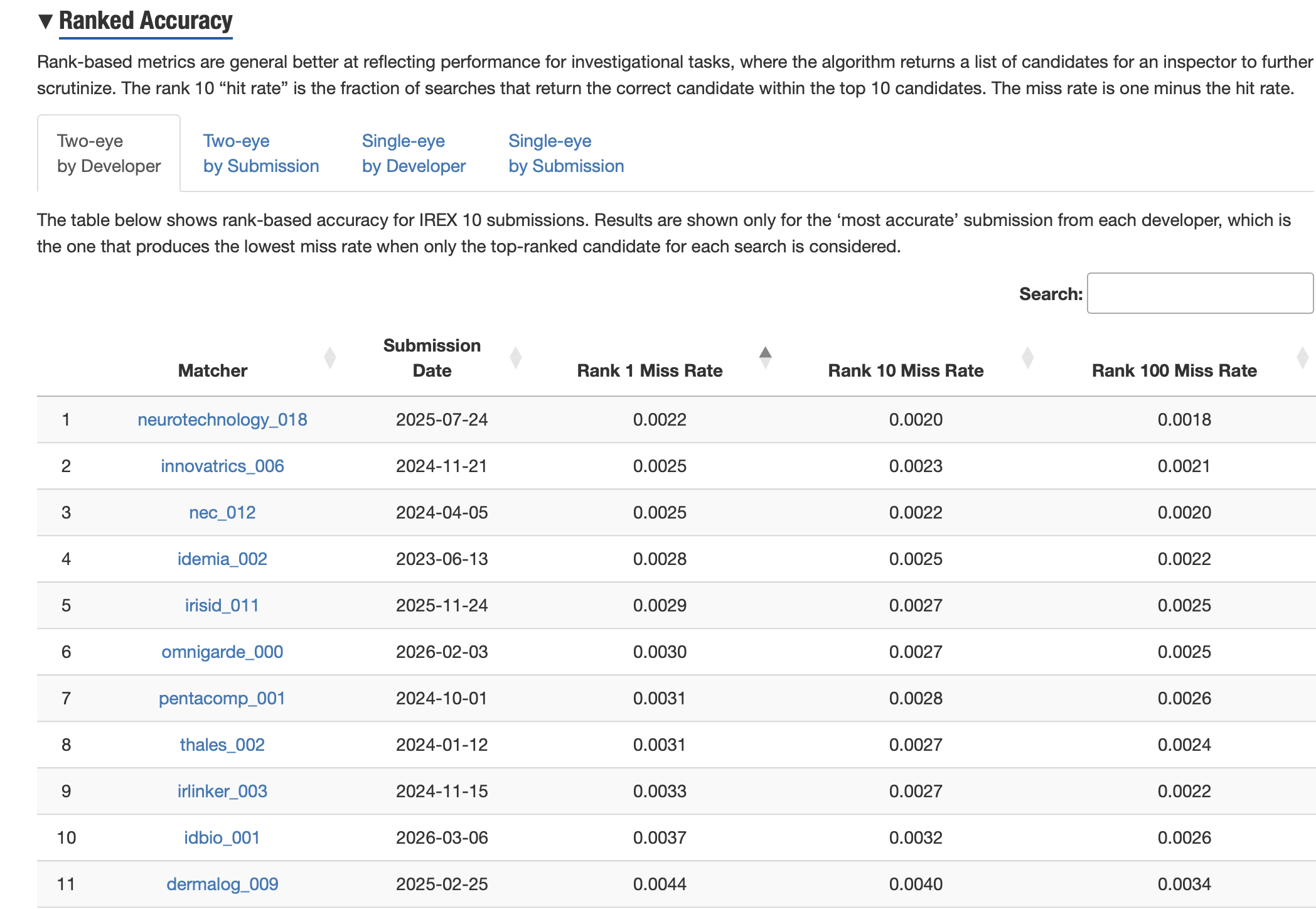
IDBIO's submission (idbio_001, evaluated 2026-03-06) achieved Top 5 placement for single-eye and Top 10 for two-eye in the NIST IREX 10 Ranked Accuracy leaderboard. But raw accuracy alone doesn't tell the full story. What makes this result truly exceptional is the convergence of very high accuracy with production-grade operational efficiency. NIST's own report card highlights the core strengths:
Each of these strengths has direct implications for real-world deployment:
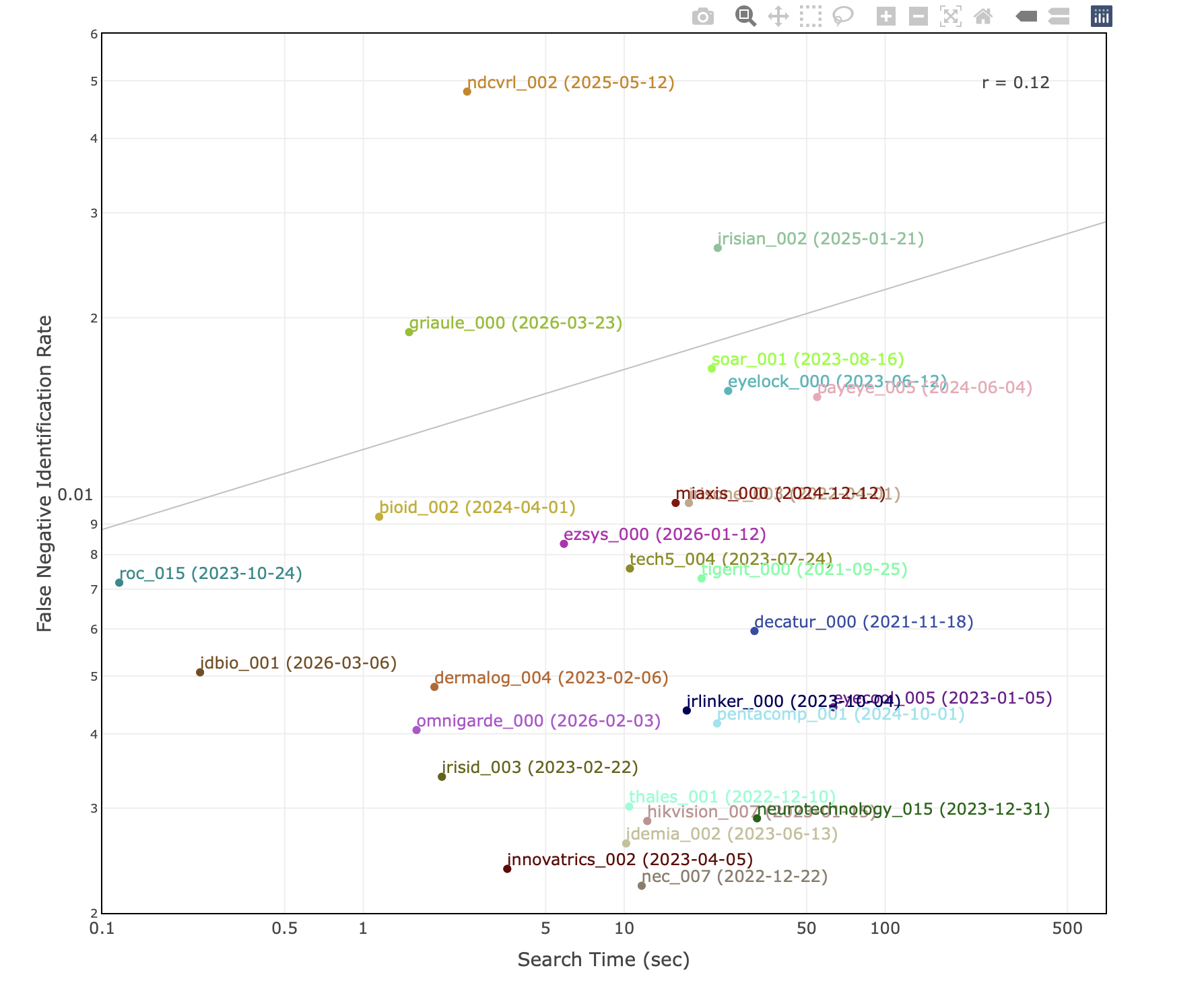
- Two-eye FNIR of 0.51% at FPIR = 0.01: 99.5% identification accuracy at an extremely strict false positive threshold. In a national ABIS serving 100 million citizens, this means fewer than 500,000 missed identifications while maintaining near-zero false matches, a critical balance for both security and citizen experience.
- Zero failure-to-enroll (FTE) rate: every single iris image was successfully enrolled. No citizen is turned away from enrollment due to algorithm limitations. For government programs with universal coverage mandates, a non-zero FTE rate is a compliance risk IDBIO eliminates entirely.
- Tight confidence intervals: NIST specifically highlights this as evidence of stable, predictable performance. The algorithm delivers consistent accuracy across the full range of the test population. For procurement teams, the accuracy you see in evaluation is the accuracy you get in production.
- Near-zero demographic bias (McFadden's R² ≈ 0): the algorithm treats every demographic group equitably. With algorithmic fairness under regulatory scrutiny worldwide, IDBIO's near-zero bias score is both a technical achievement and a compliance safeguard that de-risks national deployments.
- Fastest search time among top-ranked providers: 0.237 seconds for a 1:N search. Competitors with comparable accuracy take 11 to 32 seconds. This is the difference between real-time border control and batch-processed overnight deduplication.
- Smallest template size among top-ranked providers: 1,035 bytes per template. Competitors require 18 KB to 130 KB. At national scale (1 billion records), IDBIO's gallery fits in ~1 TB while competitors need 18 to 130 TB, a direct order-of-magnitude reduction in infrastructure cost.
Bottom-left is the optimal position: low FNIR and fast search time. IDBIO (idbio_001) achieves the best speed-accuracy tradeoff among top-ranked providers.
#1 Global Provider in Speed and Accuracy Combined
In large-scale iris identification systems (national ID programs, border control, and law enforcement), accuracy is table stakes. What separates deployable technology from lab demonstrations is operational efficiency: how fast can you search, how small are your templates, and how well does it scale?
Among all providers ranked in the IREX 10 Top 10 for accuracy, IDBIO achieves:
- Fastest search time: completing 1:N searches in a fraction of a second, far ahead of other top-ranked providers whose search times range from seconds to minutes.
- Smallest template size: reducing storage requirements by orders of magnitude compared to competitors, enabling billion-record deployments on standard infrastructure.
This positions IDBIO as the #1 choice globally for speed and accuracy combined among NIST-tested iris recognition providers. For governments and enterprises deploying at national scale, this means faster throughput, lower infrastructure costs, and real-time identification capabilities that other top-ranked providers simply cannot match.
Key Strengths of the IDBIO IREX 10 Submission
Why Speed and Accuracy Combined Defines Deployability
Most iris recognition vendors optimize exclusively for accuracy, producing large templates and slow search times. This works in lab settings but fails in production. Consider the operational requirements of a national-scale iris ABIS:
Head-to-Head: IDBIO vs the World's Top Iris Vendors
The NIST IREX leaderboard provides a direct, apples-to-apples comparison of iris recognition technology from every major vendor. Here's how IDBIO stacks up against the top 3 global biometric companies in 1:N search speed and template size:
Search time at 1M+ gallery. Lower is better. Source: NIST IREX.
Smaller templates = less storage, less bandwidth, lower infrastructure cost. Source: NIST IREX.
These aren't marginal differences. They are orders of magnitude. At national ABIS scale (100M+ records), IDBIO's speed advantage means real-time identification where other top vendors require batch processing. The template size advantage means storing an entire country's iris gallery at a fraction of the cost.
Zero Demographic Bias
A critical dimension of the IREX 10 evaluation is demographic fairness. IDBIO's near-zero McFadden's R² score means that recognition accuracy is equitable across all demographic groups. Age, gender, and ethnicity do not meaningfully affect performance. This is essential for any deployment in national ID systems where equitable treatment is not just desirable but legally mandated.
IDBIO: Now Tested by Both NIST and UIDAI
With this NIST IREX 10 result, IDBIO is now dual-tested by two of the world's most rigorous iris recognition evaluations:
- NIST IREX 10: Top 5 single-eye (Top 10 two-eye) Ranked Accuracy, #1 in speed and template size among top-ranked. The global gold standard for independent biometric testing.
- UIDAI Biometric Challenge: #1 in Iris Matching on real Aadhaar field data with age-variant demographics. The hardest operational iris benchmark in the world.
Together, these results establish IDBIO as a global leader in iris recognition, proven on both controlled NIST datasets and real-world operational data from one of the world's largest biometric systems.
In the single-eye category, IDBIO (idbio_001) ranks in the Top 5 by developer, with a Rank 1 miss rate of 0.0083, Rank 10 miss rate of 0.0071, and Rank 100 miss rate of 0.0059.
IDBIO (idbio_001) secured a Top 10 two-eye rank with the fastest search time (0.237s) and smallest template size (1,035 bytes) among all listed vendors.
View the Full NIST Report
The complete NIST IREX 10 evaluation results for IDBIO (idbio_001) are publicly available: