What Is NIST PFT III?
The NIST Proprietary Fingerprint Template III (PFT III) evaluation, conducted by the National Institute of Standards and Technology, is the authoritative global benchmark for fingerprint matching algorithms. It tests one-to-one (1:1) verification accuracy across three operationally relevant datasets at strict false match rate thresholds (FMR = 0.0001):
- Port of Entry + BioVisa (POE+BVA): Plain impressions of index fingers at 500 PPI (500 x 500 px) — visa applicant fingerprints collected at U.S. ports of entry and through visa applications.
- US-VISIT #2: Plain impressions of index fingers at 500 PPI (368 x 368 px) — border crossing verification data, similar to POE+BVA.
PFT III measures three critical dimensions: matching accuracy (FNMR at fixed FMR), comparison speed (microseconds per comparison), and template efficiency (bytes per template). Together, these determine whether a fingerprint algorithm is production-ready for national-scale identity systems.
Accuracy Leaderboard: Top 6 on NIST PFT III
matching accuracy — on par with the best
99.5% TMR @ 0.0001 FMR · US Visit · NIST PFTIII
#1 in Speed and Accuracy Combined
Among all recent PFT III submissions with competitive accuracy, IDBIO's matcher (idbio+0003, completed April 6, 2026) stands alone in combining top-tier accuracy with the fastest comparison time. At 4.0 μs per comparison, IDBIO is 28x faster than Innovatrics, 428x faster than ROC, and up to 1,250x faster than Neurotechnology — while maintaining equivalent or better FNMR across both test scenarios.
Comparing recent PFT III submissions across accuracy (FNMR), comparison speed, and template size. IDBIO achieves competitive accuracy at a fraction of the comparison time.
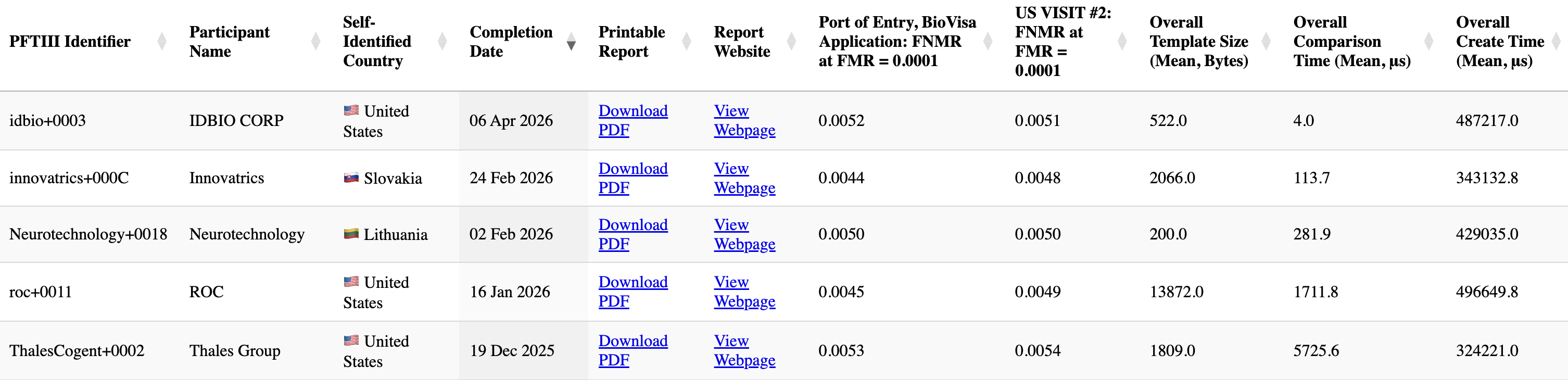
The data is unambiguous: IDBIO compares fingerprints at the microsecond level while competitors operate at the millisecond level. In high-throughput border systems processing millions of transactions daily, this translates to real-time verification versus queued batch processing.
Best Accuracy Among the Fastest Matchers
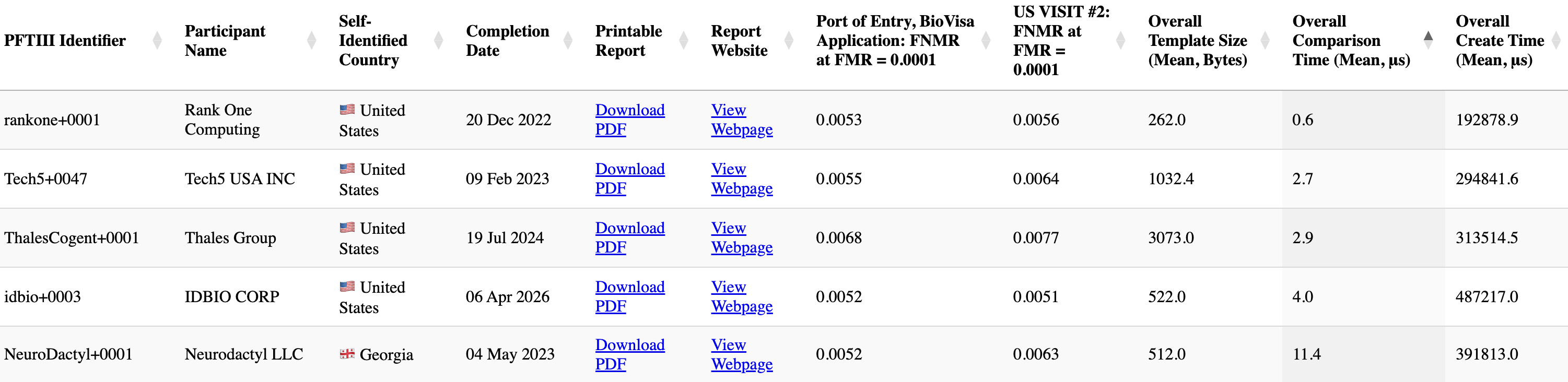
Speed without accuracy is meaningless. The inverse question is equally important: among all PFT III submissions ranked by comparison speed, which delivers the best accuracy?
When filtering for the the fastest matchers across all PFT III submissions, IDBIO achieves the lowest FNMR — the highest accuracy — in both the Port of Entry and US-VISIT evaluation scenarios. Faster matchers exist on paper, but none match IDBIO's accuracy at those speeds.
Among the the fastest matchers by comparison time, IDBIO delivers the lowest FNMR (best accuracy) across both evaluation scenarios.
Performance Breakdown
Why Speed and Template Size Matter at Scale
Fingerprint matching in national identity systems is not a single-transaction problem. Border control systems process tens of thousands of verifications per hour. ABIS platforms run deduplication across databases of hundreds of millions. At these scales, the difference between 4 μs and 5,000 μs per comparison is the difference between real-time operation and infrastructure that cannot keep up.
Head-to-Head: Recent Top Submissions
Mean comparison time in microseconds. Lower is better. Best submission per vendor. Source: NIST PFT III.
Mean template size. Smaller templates reduce storage, bandwidth, and infrastructure cost. Best submission per vendor. Source: NIST PFT III.
NIST-Tested Across Modalities
With this PFT III result, IDBIO now holds top NIST rankings across both fingerprint and iris modalities:
- NIST PFT III: #1 in Speed & Accuracy Combined among recent top-accuracy submissions. Best accuracy among the the fastest matchers globally.
- NIST IREX 10: Top 10 Ranked Accuracy, #1 in speed and template size among top-ranked iris providers.
For governments and enterprises evaluating multi-modal biometric systems, IDBIO is the only provider with independently tested, top-tier performance across fingerprint and iris matching from a single vendor.
View the Full NIST Report
The complete NIST PFT III evaluation results for IDBIO (idbio+0003) are publicly available: